Creates a vector of extracting the Nth value from each entry in a vector of tuples. More...
#include <value.hpp>
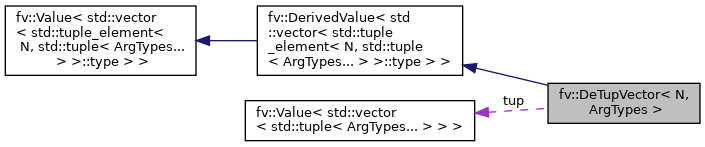
Inheritance diagram for fv::DeTupVector< N, ArgTypes >:

Collaboration diagram for fv::DeTupVector< N, ArgTypes >:
Public Member Functions | |
| DeTupVector (Value< std::vector< std::tuple< ArgTypes... >>> *tup, const std::string &alias) | |
 Public Member Functions inherited from fv::DerivedValue< std::vector< std::tuple_element< N, std::tuple< ArgTypes... > >::type > > Public Member Functions inherited from fv::DerivedValue< std::vector< std::tuple_element< N, std::tuple< ArgTypes... > >::type > > | |
| DerivedValue (const std::string &name, const std::string &alias="") | |
| void | log () |
| std::vector< std::tuple_element< N, std::tuple< ArgTypes... > >::type > & | get_value () |
| Calculate, if necessary, and return the value held by this object. | |
| Public Member Functions inherited from fv::Value< std::vector< std::tuple_element< N, std::tuple< ArgTypes... > >::type > > | |
| Value (const std::string &name, const std::string &alias="") | |
| void | enable_logging (const std::function< std::string(std::vector< std::tuple_element< N, std::tuple< ArgTypes... > >::type >)> &value_to_string=[](std::vector< std::tuple_element< N, std::tuple< ArgTypes... > >::type >){return "";}) |
| void | disable_logging () |
Protected Member Functions | |
| void | update_value () |
| Updates the internal value. More... | |
Private Attributes | |
| Value< std::vector< std::tuple< ArgTypes... > > > * | tup |
Additional Inherited Members | |
| Protected Attributes inherited from fv::DerivedValue< std::vector< std::tuple_element< N, std::tuple< ArgTypes... > >::type > > | |
| std::vector< std::tuple_element< N, std::tuple< ArgTypes... > >::type > | value |
| Protected Attributes inherited from fv::Value< std::vector< std::tuple_element< N, std::tuple< ArgTypes... > >::type > > | |
| std::function< std::string(std::vector< std::tuple_element< N, std::tuple< ArgTypes... > >::type >)> | value_to_string |
Detailed Description
template<size_t N, typename... ArgTypes>
class fv::DeTupVector< N, ArgTypes >
Creates a vector of extracting the Nth value from each entry in a vector of tuples.
Member Function Documentation
◆ update_value()
template<size_t N, typename... ArgTypes>
|
inlineprotectedvirtual |
Updates the internal value.
This function should be overridden by any child class to do the actual work of updating value based on whatever rules the class chooses. Normally, this consists of geting the values from some associated Value objects, doing some calculation on them, and storing the result in value.
Implements fv::DerivedValue< std::vector< std::tuple_element< N, std::tuple< ArgTypes... > >::type > >.
The documentation for this class was generated from the following file:
- /home/caleb/Sources/TTTT/filval/value.hpp
